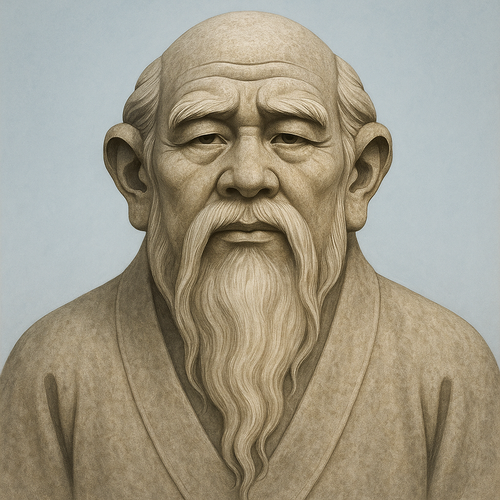
Lao Tzu (also written as Laozi) was an ancient Chinese philosopher and writer, traditionally credited as the author of the Tao Te Ching — one of the most translated and widely read texts in human history. Believed to have lived in the 6th century BC, he is revered as the founder of Taoism and one of the most influential thinkers the world has ever known. According to legend, he served as a royal archivist in the Zhou court before departing westward, leaving behind his timeless teachings at the request of a border guard.
The Tao Te Ching, a compact collection of 81 verses, explores the nature of the Tao (the Way) — the fundamental force underlying all existence. Lao Tzu's teachings emphasize harmony with the natural order, the power of simplicity, and the wisdom of yielding over force. His concept of wu wei (non-striving or effortless action) has resonated across millennia and cultures, offering profound guidance for anyone navigating the complexities of modern life — from leadership and decision-making to stress, relationships, and personal fulfillment.
For listeners on a journey of personal development, Lao Tzu's wisdom is as urgent and relevant today as it was 2,500 years ago. His teachings invite us to slow down, trust the process, and discover strength in stillness. The Nightingale-Conant tradition of transformational audio learning finds a natural companion in Lao Tzu's philosophy — a reminder that lasting success grows not from struggle alone, but from alignment with deeper principles of life.